
$300 million SouthWorks project aims to meet community needs
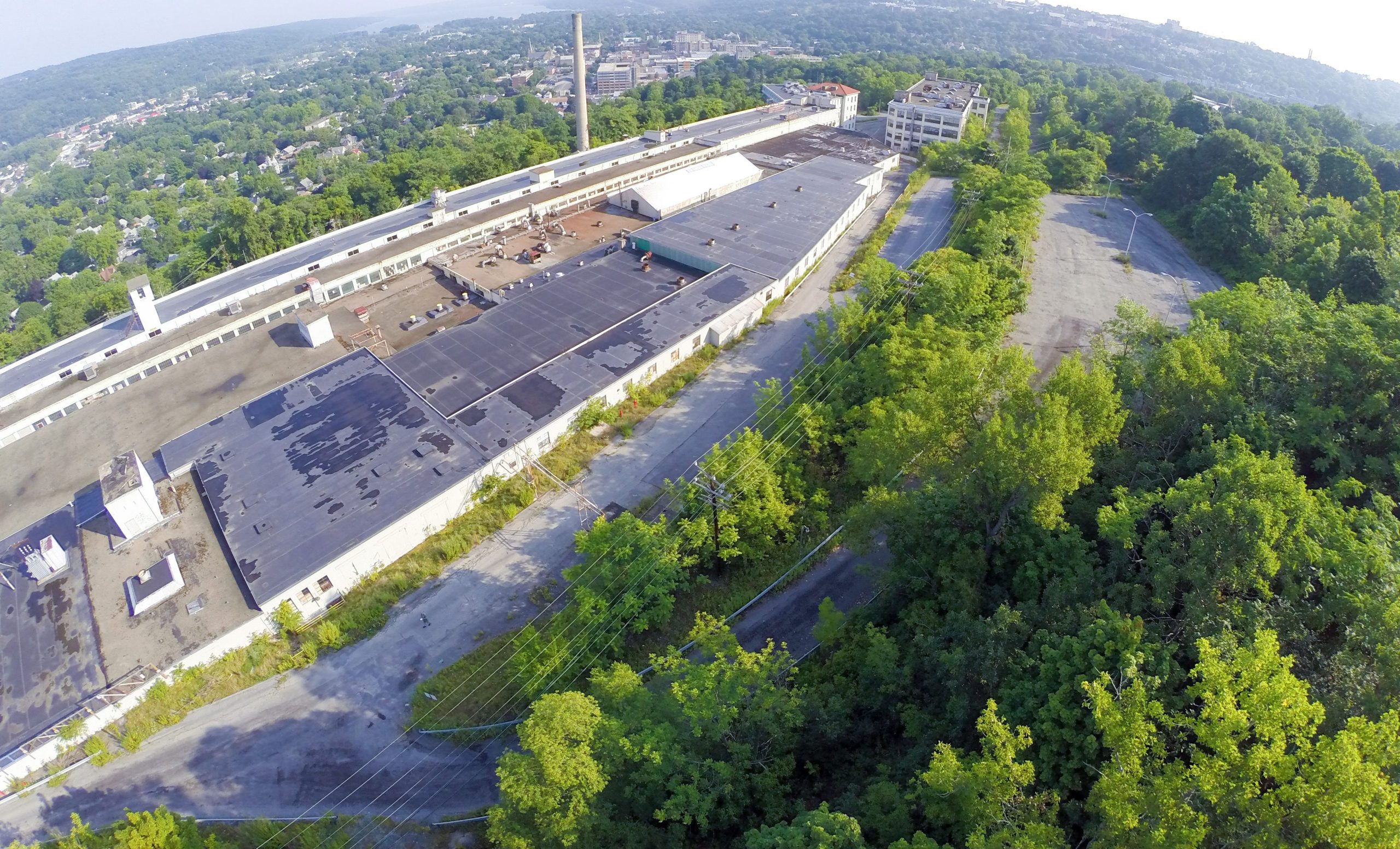
An aerial view of the Chain Works District, previously home to a variety of manufacturers including, most recently, Emerson Power Transmission. The site will soon be home to the upcoming SouthWorks development project, a mixed-use neighborhood set to include housing, commercial space and industrial areas meant to boost Ithaca’s economy. Photo provided.
For over a decade, the area of Ithaca known most recently as the Chain Works District — located at 620 S. Aurora St. — sat vacant. Behind the scenes, a project began to develop that aims to transform the formerly industrial area into something that would benefit the whole community, and partners involved finally completed the real estate closing for the project just this month.
The $300 million development project has been dubbed SouthWorks, described in a recent press release as “a new mixed-use neighborhood, including housing, technology, commercial, retail and industrial/manufacturing to serve as a catalyst for Ithaca’s local economy.” The project will also develop the Gateway Trail, which runs at the base of the property, and connect the South Hill Recreation Trail to Buttermilk Falls and the Kirby Edmunds Bridge.
According to the release, SouthWorks is led by SHIFT Capital — a self-described “social impact real estate firm” based in Philadelphia, Pennsylvania — and the property’s previous developer, David Lubin from L Enterprises in Ithaca.
Additional partners include the minority- and woman-owned firms US Ceiling Corp, led by Melissa James-Geska, and Xylem, led by Nnenna Lynch. Vicki Taylor Brous, an Ithacan, serves as the project coordinator. The partners are also working with CJS Architects, Fagan Engineers, SCAPE Landscape Architecture, Buro Happold and Taitem Engineering as sustainability consultants.
SouthWorks as a project has its origins back in July of 2013, when Emerson Power Transmission — which had been the manufacturer at the site from 1983 to 2011 — selected Lubin to take over the site’s development.
“Emerson and Lubin, with guidance from the Department of Environmental Conservation (DEC), then partnered over the next decade to make the 95-acre property one of New York State’s most thoroughly environmentally investigated and remediated sites,” the release described.
It took thousands of tests, tracing and planning, but now, the site has been remediated to residential standards. The site management plan was approved by the DEC in October of this year.
“SouthWorks is a landmark project that will help define, bolster and advance the Ithaca region, generating thousands of jobs and economic opportunity for generations to come,” Lubin said in the release. “I look forward to working with the new team to ensure that this project represents the kind of development I imagined when I began planning it a decade ago: commercial space for industrial/manufacturing and small businesses, housing options, parks, and public art. It is rooted in the community and will anchor the continuing revitalization of the region.”
While Lubin has been involved since the beginning, others got involved later, like SHIFT. SHIFT Capital Partner and CEO Brian Murray explained that Ithaca Area Economic Development reached out to SHIFT about a year ago, feeling that the SouthWorks project would align well with SHIFT’s focus.
“We do a lot of adaptive reuse projects, we do a lot of neighborhood projects, and this checks all those boxes, but it’s also probably one of the most unique sites in the country because of its proximity to downtown,” Murray told Tompkins Weekly. “The anchoring of educational institutions in Ithaca, the need for housing, plus the type of businesses that are coming out of the Ithaca area, all really made sense for what we do, which is a combination of bringing all of these pieces into a place that can thrive.”
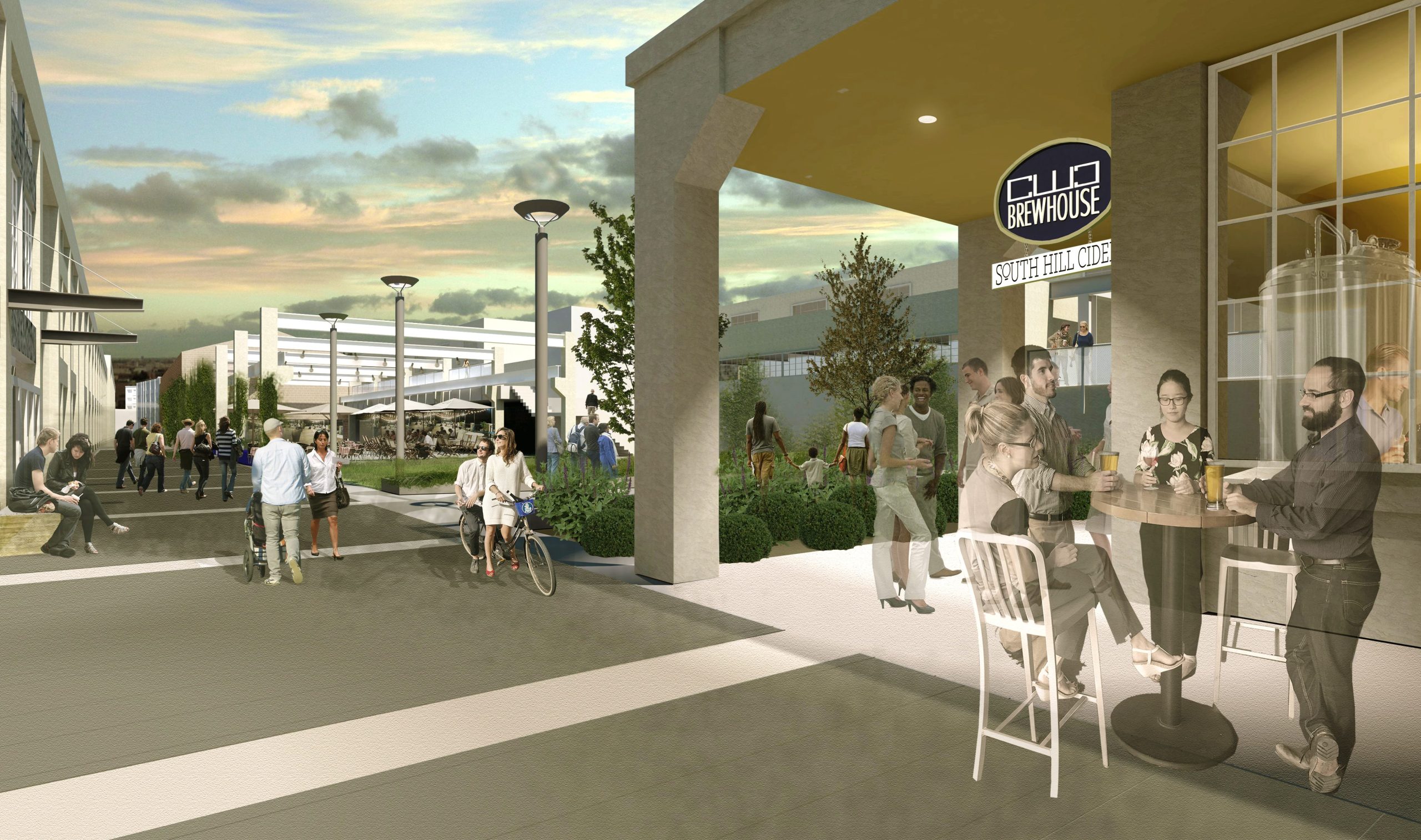
A rendering of a portion of the upcoming SouthWorks project, a mixed-use neighborhood set to include housing, commercial space and industrial areas meant to boost Ithaca’s economy. The project is being led by a variety of partners and is planned for the former Chain Works District. Photo provided.
Murray then brought on Lynch and James-Geska, who were excited to join the endeavor.
“I was immediately intrigued and for all the reasons that Brian laid out — large scale, transformational, impactful,” Lynch said. “I got into this business to make an impact through real estate, using real estate to make an impact in communities. The work I do is really about creating thriving communities. And so, this project is essentially creating a whole new neighborhood, but also, given where it sits within Ithaca, … it really has an important role to play from a planning perspective. We are connecting these different parts of the city and town.”
When planning SouthWorks, the partners had several goals in mind, all centered around strengthening Ithaca’s assets and meeting community needs. For example, SouthWorks involves lots of nature aspects, like trails and outdoor space.
“You want to leverage and build on the foundation of things that are in Ithaca, which, of course, is an embrace of the outdoors and activity, and so, it’s really multi-dimensional, and it’s going to have something for everyone,” Lynch said.
Murray added that SouthWorks is also meant to create a space for “commercial groups that want to stay in Ithaca or are leaving the Ithaca area for the wrong reasons as opposed to having reasons to stay and having places to stay.”
One of the biggest and most important aspects of SouthWorks is the housing, Murray said.
“Ithaca’s a little bit of a microcosm for the entire country as it relates to housing right now,” he said. “There’s a shortage of middle-income housing, there’s a shortage of affordable housing, and there’s just [a] constant shortage of market housing. And so, those are things that we want to make sure that we’re touching on with the site across the board, incorporating the affordable piece of it to the middle income piece of it, and market rate as well.”
Taylor Brous said that workforce housing is among the harder elements to get right.
“Workforce housing is the hardest to build,” she said. “It is not subsidized as affordable housing would be. But it’s not market, where you can recoup the costs of building. So, we’re really exploring, how do you build workforce housing that makes it so you can touch on that market and really relieve some of the pressures that come to that group in this community?”
SouthWorks partners said that since the project was announced, the community reception has been mostly positive.
“This all took a lot of time, so I think people have been relieved that this project is moving forward and really want to engage in the project,” Taylor Brous said. “We’ve had dozens of emails already with people saying, ‘connect the trails,’ and ‘what kind of housing are you going to be building?’ And for me, as a community member, to be able to answer those questions with thoughtful, community-driven knowledge of what this team can do, I’m able to answer very positively, and that’s been encouraging for me and, I think, just a sign of what’s to come.”
As far as what’s next, sources said they still have a long road ahead to make their idea a reality. The next big milestone is a workforce development project from the team that is expected to be announced next year, Taylor Brous said.
“One of the elements of that is looking at underserved and underrepresented people in the construction industries, whether it’s construction business acceleration or bringing people into the construction trades,” she said. “So, we’re collaborating on a project in workforce development and then hope to expand that beyond construction to include other industries that will be served on the property. For me, it’s also focusing on demolition and grant writing and all of the pieces that need to come together.”
Looking further ahead, Murray said that he expects SouthWorks will face the sorts of challenges that development projects have been facing for some time now — the staffing shortage and supply chain issues Tompkins Weekly has covered before (tinyurl.com/2mpggnx8).
For now, the team has its eyes set on next year, Murray said.
“The next year is going to be sharing some information with the community, giving input, seizing opportunities that I think are going to be coming up,” he said. “I think we’ll maybe be pivoting a lot the next 12 months as we think about all the pieces.”
Announcements regarding the next phase in the development are expected in early 2023. For more information on SouthWorks, visit southworksithaca.com.
Jessica Wickham is the managing editor of Tompkins Weekly. Send story ideas to them at editorial@VizellaMedia.com.
Related Articles
Cayuga Medical Center nurses’ vote for unionization approaches
The Cayuga Medical Center nurses union vote approaches as nurses cite workplace concerns, leadership changes, and national labor issues.

Holiday traditions bring community cheer
Tompkins County holiday traditions light up homes, farms, and schools with festive cheer and community spirit.