
Upcoming deadline sparks debate over marijuana sales

Editor’s note: A previous version of this story reported that the Village of Lansing had opted out of both retail marijuana dispensaries and onsite consumption facilities. This has since been corrected. The village only opted out of onsite consumption facilities.
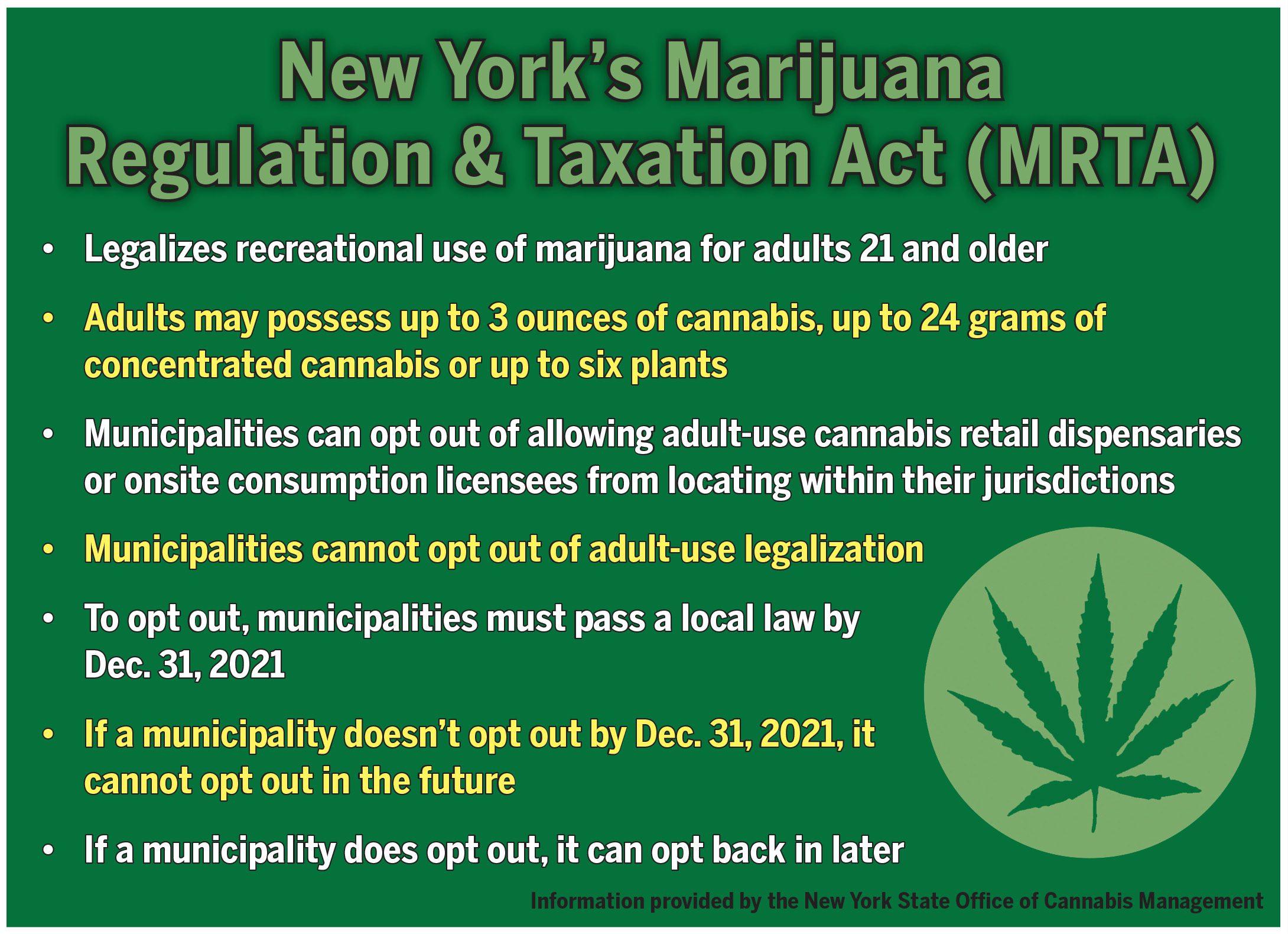
Last spring, former Gov. Andrew Cuomo signed a bill that made recreational marijuana legal statewide. While it will likely take several more years before dispensaries arrive in the county, a looming deadline is pushing many municipalities to consider whether to opt out of allowing dispensaries or onsite consumption facilities within their jurisdiction before the end of the year.
According to the New York State Office of Cannabis Management (cannabis.ny.gov/local-government), municipalities across the state face a Dec. 31, 2021, deadline to pass a local opt-out law.
“Cities, towns and villages can opt-out of allowing adult-use cannabis retail dispensaries or on-site consumption licenses from locating within their jurisdictions,” the website reads. “Municipalities cannot opt-out of adult-use legalization. Adult-use cannabis possession and use by adults 21 years of age or older in accordance with the Marijuana Regulation & Taxation Act (MRTA), is legal in New York state.”
If a municipality doesn’t opt out by the Dec. 31 deadline, it won’t be able to opt out in the future. But if it does choose to opt out, it can opt back in to allow either or both retail dispensaries or onsite consumption license types. Local laws opting out are subject to a permissive referendum, allowing voters within municipal lines to petition the government and place the approval of the local law on the next general or local election ballot.
Some municipalities have already made up their mind on the opt-out decision, as several city, town and village leaders told Tompkins Weekly.
“The Town of Ithaca will not be opting out,” said Rod Howe, town of Ithaca supervisor, in an email. “We have been waiting for the NYS Cannabis Control Board to be in place. The Town’s Planning Committee will discuss this topic in 2022 and provide some recommendations for the full Town Board to consider — mainly where sales might be allowed. We have had some inquires.”
It’s a similar story for the town of Dryden. Town Supervisor Jason Leifer said he has no plans to bring an opt-out law to the Town Board floor, and he hasn’t seen much interest in doing so from fellow Town Board members either.
“It’s not really being debated,” he said. “I don’t think the Board wants to do it. Last month, I provided the Board with basically drafts of three versions of an opt-out, and last [week], when someone asked about it, I said, ‘I’m personally not going to introduce them because I don’t believe we should opt out at all.’”
Rordan Hart, mayor for the village of Trumansburg, said that his municipality is not considering an opt-out either.
“We did discuss this specifically at a Village Board meeting, I want to say back in mid- to late summer, whether or not there was any sentiment on the part of the Board to consider an opt-out,” he said. “The unanimous sentiment of the Board was that it’s not something we’re interested in opting out from. … It wasn’t necessarily a sense of whether Board members thought it was a great idea or a terrible idea. It was just, ‘This is not something that we feel the community wants us to dedicate the time and attention to avoiding.’”
Meanwhile, some municipalities have already decided to opt out, like the villages of Dryden and Lansing. At its Nov. 15 meeting, the Village of Lansing Board of Trustees voted to opt out of allowing onsite consumption establishments, though members chose not to opt out of retail dispensaries.
“More and more high school and middle school kids are doing marijuana,” said Village Trustee Randy Smith, who is also on the board of the Tompkins County Youth Services Department, at the meeting. “The kids actually believe that it will not and cannot harm them. It’s the kind of information that’s been fed to them over time. And they believe that alcohol could harm you, but the marijuana won’t. And I think that in allowing this, that we’re giving a message to the kids that it’s OK to smoke. That’s how I feel about it.”
And some municipalities are still deciding whether to opt out, like the towns of Enfield and Newfield. At its Nov. 10 meeting, the Enfield Town Board voted to hold a public hearing on the matter, which is scheduled to take place at the Town Board’s Dec. 8 meeting. Councilperson Robert Lynch drafted the local law to opt out, and he explained that he did so as an insurance policy, as the town can change its mind later.
“I thought that we should have a firm discussion of it because I would hate to have buyer’s remorse later on, that it gets to be February or March, residents come to our town and say, ‘Why didn’t you opt out of it back when you could? We don’t want these dispensaries in Enfield,’” Lynch said. “I’m open-minded. If our residents come to the Town Board public hearing in December and say, ‘We want to permit them. We like the idea of tax revenue from these dispensaries and we see nothing that’s socially wrong about having them,’ I will vote against an opt-out law.”
Enfield Town Supervisor Stephanie Redmond added that while she personally doesn’t want the town to opt out, she understands that some of her fellow board members are concerned about the current lack of concrete state regulations on the matter, like where dispensaries can be located.
“Some of our board members are leaning to opting out of the law to allow dispensaries and onsite consumption in our township for the time being until we have further information about the regulations that will be put in place by the state,” she said. “Those are not finalized at this point. So, it’s hard for our Town Board members to give an OK, I guess you’d say, for the dispensaries and onsite consumption facilities [to be] open without knowing what the state regulations will have in place.”
For those in favor of opting out, that lack of regulation clarity is a big motivation behind their stance, as several sources told Tompkins Weekly. But those who favor not opting out cite the possible benefits it could bring to their area, particularly in the form of tax revenue.
“I am a big proponent of [opting] in because the revenue that will be generated through the taxes of dispensaries will really help our town,” Redmond said. “Four percent of all sales tax will be directed towards local government. I think 25% of that 4% will go to county, but 75% of that 4% … will go to our township. … Our town has the lowest economic standing in Tompkins County, and I feel that that revenue will give a lot of tax relief to our residents and allow us to move forward with some of the issues that our town is facing.”

And there are already some eager to see dispensaries in their area or even start one of their own, as is the case with James Stout, owner of Stout’s Hemp Shop in Ithaca. He said he plans to apply for a license to open a recreational dispensary once regulations at the state level are finalized, and many of his customers are excited for him.
“I get people in every single day — ‘Oh, do you sell recreational here?’” he said. “[I say,] ‘No, you can’t. It’s legal in the state, but we cannot do that yet. There’s no license for it.’ Literally every day, all day long, from people that are 21 to, honestly, elderly people coming in, looking forward as well. People of all ages, they seem to be very excited. I haven’t really had any customers come in and really frown upon it, to be honest.”
Calvin Edith, manager of Headdies on the Ithaca Commons, said he’s received a similar response from his customers.
“Everybody wants to come in and talk about it,” he said. “I think it’ll open up a new market for us because there’s a lot of people who are just now finding out about how cannabis works and how it’s pretty much harmless. A lot of those people don’t necessarily know where to get it, though they might want to try it. So, I think once we see some dispensaries opening up, we’ll see a whole new type of customer walk through.”
Though most sources Tompkins Weekly interviewed were either in favor of or against opting out of both dispensaries and onsite consumption facilities, some were split on the issue. Tompkins County Sheriff Derek Osborne, for example, said that he’s in favor of allowing retail dispensaries but has concerns regarding onsite consumption facilities.
“I like the idea of people having the right to do what they want in their own homes, and for the most part, I think most people make the correct choices,” he said in an email. “However, I believe on-site consumption will involve people using marijuana and then leaving in a motor vehicle. At this point, other people are placed at risk from impaired drivers. We see this happening consistently with people who consume alcohol. Despite our best efforts to educate and enforce DWI laws, this remains a constant issue in our society.”
County Undersheriff Jennifer Olin added that handling DWI problems involving marijuana are much more complicated than alcohol-related DWI.
“Testing for drug impairment is problematic due to the limitations of drug-detecting technology and the lack of an agreed-upon limit to determine impairment,” she said in an email. “The nationally recognized level of impairment for drunken driving is .08 g/mL blood alcohol concentration. But there is no similar national standard for drugged driving. Drugs do not affect people consistently. Drugs such as marijuana can also stay in the system for weeks, thus appearing in roadside tests while no longer causing impairment.”
In addition to DWI worries, marketing to minors was another common concern among local leaders like Legislator Shawna Black, member of the recently merged STOP-DWI and Traffic Safety Board (see t.ly/zQ2D). Black said that proper state regulation could go a long way toward addressing that issue.
“Some of the gummies come in packages that mimic sour patch kids,” she said in an email. “If those get in the hands of our young kids and they think it’s candy — the results could pose serious health concerns. … New York state needs to put rules in place that provide edibles to be clearly marked and not resembling popular candies.”
As far as what others would like to see out of eventual state regulations, several sources said they’d like to get clear guidance on where dispensaries can be located, especially ensuring that they’re not close to a school or other places where children congregate.
Edith added that he’d like to see specific attention brought to minority business owners. The Office of Cannabis Management said on its website (cannabis.ny.gov/licensing) that its goal is to award 50% of licenses for recreational dispensaries to social and economic equity applicants, and while Edith is in support of this move, he said ensuring proper equity with this issue will require more work.
“A lot of those disenfranchised people have been left at a disadvantage because of the harmful effects that prohibition has had on us,” he said. “So, a lot of people that couldn’t get these licenses won’t be able to afford it. So, I think it would be really important to set in place some kind of assistance or guarantee or anything to help these people get business loans.”
For more information about the state’s legalization of recreational marijuana, visit cannabis.ny.gov.
Jessica Wickham is the managing editor of Tompkins Weekly. Submit story ideas to them at editorial@vizellamedia.com.
Related Articles

Holiday traditions bring community cheer
Tompkins County holiday traditions light up homes, farms, and schools with festive cheer and community spirit.
The gift of an experience: Local businesses offer hands-on holiday fun
Holiday experience gifts in Tompkins County include candle making, gourd crafts, and pottery workshops for creative seasonal fun.
Code Blue shelter opens amid praise, concerns and ongoing debate
Ithaca’s Code Blue shelter opens with larger space, showers, and case management to help residents during cold weather.